SOCIAL & ECONOMIC JUDGEMENT: FROM SHOPPING CHOICES TO PRICE TAGS
SOCIAL & ECONOMIC JUDGEMENT: FROM SHOPPING CHOICES TO PRICE TAGS
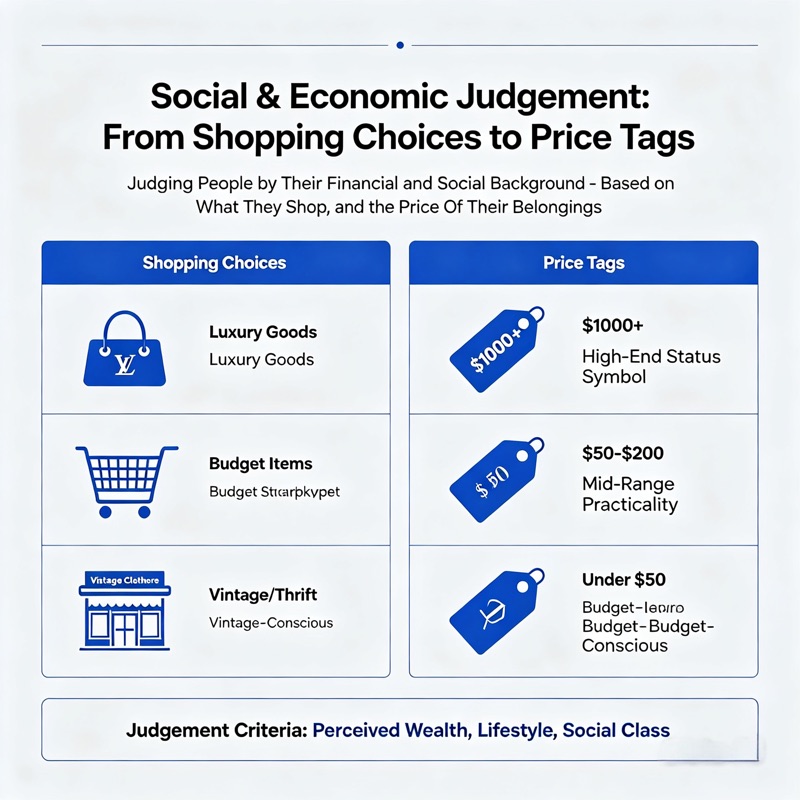
Judging People by Their Financial and Social Background — Based on What They Shop, and the Price Of Their Belongings
Published: June 02, 2026
Category: Society & Culture • Fashion Philosophy • Ethical Living • G&T Deep Dive
For as long as human society has existed, we have looked at the things people own, wear, and buy to understand who they are. From ancient times when clothing materials, colors, and accessories were legally restricted to certain classes, to today’s modern world where logos, labels, and price points act as silent signals, the habit of judging others based on their possessions is deeply embedded in our culture. We look at a handbag, a pair of shoes, a phone, or a piece of clothing, and instantly we form an opinion: Is she wealthy? Is he successful? Are they from a good family? Do they belong here? This system of social and economic judgment has become so automatic that we rarely stop to question it, yet it shapes nearly every interaction we have — from how we treat strangers in stores, to how we value friends and colleagues, to how we view ourselves. It is a complex, often unfair, and deeply revealing part of how we live, and understanding it is essential to the values we uphold here: that worth is never defined by a price tag, and that true style and character exist far beyond what we can buy.
🛍️ THE LANGUAGE OF POSSESSIONS: HOW WE LEARN TO JUDGE
Judging people by what they own begins very early, influenced by family, education, media, and the world around us. We are taught from childhood that certain items represent success, status, or “good taste,” while others are associated with lack, struggle, or inferiority. In schools and neighborhoods, children are often separated or ranked based on the brands they wear, the gadgets they carry, or the way they dress. As we grow older, these ideas harden into unwritten rules. We learn that a luxury logo signals wealth, that a designer label implies sophistication, and that budget or generic items suggest lower social standing or less financial success.
This system works like a silent language. When we walk into a room, our eyes scan for these signals automatically. A watch, a car, a pair of sunglasses, or even the type of coffee someone is drinking becomes data we use to place them in a mental hierarchy. Advertisers and brands intentionally feed this behavior, marketing their products not just as useful or beautiful, but as symbols of identity, achievement, and belonging. They tell us: Buy this, and you will be respected. Wear this, and you will be admired. Own this, and you will matter. Over time, we begin to believe it, and we start judging others — and ourselves — according to this artificial scale.
The problem with this language is that it is incredibly shallow and often completely wrong. A person wearing expensive clothes might be living paycheck to paycheck, in debt, or wearing borrowed items. Someone in simple or affordable clothing could be wealthy, choosing to spend their money on things they value more than appearance, or simply preferring modesty. A handbag with a famous brand name does not tell you if the person carrying it is kind, intelligent, hardworking, or honest — yet we regularly use it to decide whether they deserve our respect, attention, or consideration.
📊 SHOPPING CHOICES AS A SOCIAL IDENTITY CARD
Shopping is never just about getting what we need; it is one of the primary ways we perform and present our identity to the world. Every purchase is a choice, and every choice carries meaning. When we choose to shop at high-end boutiques or luxury department stores, we are participating in a system that signals exclusivity and affluence. When we choose fast fashion, thrift stores, local markets, or budget retailers, society often interprets that as a sign of limited means or lower social class. These interpretations are so strong that they change how people are treated in real life: sales assistants may be more attentive or welcoming to those carrying luxury shopping bags, while ignoring or looking down on those who carry generic or reusable bags. Service quality, politeness, and even basic respect are frequently distributed based on where someone shops and what they are seen buying.
What makes this judgment particularly unfair is that shopping choices are influenced by so much more than just how much money someone has. Personal values play a huge role: many people with significant wealth choose not to spend on expensive brands because they care about sustainability, ethics, minimalism, or supporting local businesses. They may prefer quality over branding, or they may simply not see the point in paying extra for a name. Conversely, people with lower incomes may choose to save for months or even years to buy one high-value item, not out of vanity, but because they want to feel confident, included, or proud of something they worked hard for.
Cultural background also changes how people shop. In some cultures, visible displays of success are important ways to honor family or show achievement; in others, modesty and understatement are seen as the true marks of good character. Needs and circumstances differ too: a student, a young parent, someone saving for a home, or someone supporting a family member will naturally make different shopping choices than someone with fewer responsibilities. Yet society rarely considers these reasons — it looks only at the price tag and makes a snap judgment about intelligence, worth, or background.
We also judge how people shop: someone who carefully compares prices, looks for sales, or asks for discounts is often labeled as “cheap,” “struggling,” or “lower class,” while someone who spends freely without checking costs is seen as “successful,” “generous,” or “elite.” This ignores the reality that careful spending is often a sign of intelligence, discipline, and good financial management — qualities that are actually associated with long-term success and stability. Meanwhile, reckless or excessive spending is often celebrated even though it frequently leads to debt and insecurity. The standards we use are completely backwards: we praise wasteful spending and judge responsible choices, simply because of what they signal socially.
🏛️ CLASS PERCEPTIONS: THE PRICE TAG MYTH
At the heart of this behavior lies a deep-seated belief: that the price of an item directly reflects the worth of the person who owns it. We assume that expensive things equal a valuable person, and affordable things equal a person of lesser value. This is what we call The Price Tag Myth, and it is one of the most damaging misconceptions in modern society. It creates a world where people are ranked, respected, or rejected based entirely on what they consume, rather than who they are.
This myth creates two very different but equally harmful experiences. For those who can afford high-priced items, it creates pressure to maintain appearances, to keep buying, and to constantly upgrade in order to stay “relevant” or “respected.” It ties their self-worth to their spending power, making them anxious about losing status if their financial situation changes. For those who cannot afford expensive brands, it creates feelings of inadequacy, shame, and exclusion. They are made to feel that they are less important, less stylish, or less successful simply because they do not spend as much. It creates a divide — a visible barrier — between people of different financial backgrounds, turning everyday activities like shopping or dressing into acts of social performance rather than personal enjoyment.
The reality, however, is that price and value are rarely the same thing. In fashion, for example, the difference between a ₱500 dress and a ₱50,000 dress is rarely about quality, fabric, or design — it is mostly about branding, marketing, and the artificial status attached to the name. The ₱500 item can be just as beautiful, well-made, and stylish; the ₱50,000 item can be mass-produced, low-quality, or poorly designed. Yet society treats the owner of the expensive one as superior. We see this clearly in our own discussions about style: true fashion wisdom is about knowing how to choose, combine, and wear items with confidence and purpose, regardless of cost. Icons we admire — from Catriona Gray and Margie Moran to Sydney Sweeney and Olivia Rodrigo — have all shown us that they can look breathtaking in couture and equally stunning in simple, accessible clothing. They prove that the magic is never in the price tag, but in the person wearing it.
Judging people’s social or economic background based on what they own is also incredibly inaccurate. There are people born into wealth who live modestly, and people born into humble beginnings who have built great success but choose not to show it. There are people who appear wealthy but are living beyond their means, and people who appear simple but are financially secure. Financial status is complex, private, and constantly changing, yet we act as if a pair of shoes or a phone gives us the full story. This kind of judgment is not just unfair — it is lazy and uninformed. It reduces complex human beings to nothing more than a receipt, and it blinds us to the richness, talent, and character that exist in every person, regardless of their bank account.
⚖️ THE HARM OF JUDGMENT: HOW IT SHAPES OUR LIVES
The consequences of social and economic judgment go far beyond hurt feelings. It creates a culture of inequality, where opportunities, respect, and relationships are distributed based on consumption rather than merit or character. In professional settings, people are often perceived as more competent, trustworthy, or authoritative if they dress expensively or own luxury items, even though there is no connection between those things and actual skill or ability. In social circles, people may be excluded, overlooked, or treated differently because they do not fit the expected “image” of the group. It creates anxiety and pressure: many people admit to buying things they do not even like or need, just to avoid being judged or looked down upon. It makes shopping stressful rather than enjoyable, turning every purchase into a potential test of status.
Worst of all, it changes how we see ourselves. When we grow up in a world that constantly tells us our worth is tied to what we buy, we begin to believe it. We start judging ourselves by the same harsh standards, feeling proud when we buy something expensive and feeling ashamed when we cannot. We lose sight of what actually matters: our kindness, our talents, our hard work, our relationships, and our happiness. We trade real self-worth for artificial status, and in doing so, we become consumers rather than people.
This judgment also affects how we view success and achievement. We tend to equate success with displayed wealth — big houses, luxury cars, designer clothes — rather than with stability, freedom, happiness, or contribution to society. We admire people who spend conspicuously, while overlooking those who live well, give generously, or build meaningful lives quietly. We even judge entire professions or lifestyles based on their expected spending power, looking up to high-paid jobs and looking down on essential but lower-paid work, regardless of how important or honorable that work may be.
✨ REDEFINING WORTH: BEYOND THE PRICE TAG
So, what is the alternative? If we stop judging people by what they shop for and the price of their belongings, what do we replace it with? The answer is simple but powerful: judge people by their choices, their character, and their confidence — not their cost.
True style, true elegance, and true success have nothing to do with how much you spend. They have to do with how you choose, how you wear, and how you carry what you have. A person who finds a beautiful, affordable item and styles it with creativity and pride shows more taste and intelligence than someone who simply buys the most expensive thing available because of the name. Someone who shops ethically, sustainably, or locally shows values that are far more valuable than any brand logo. Someone who wears simple clothes with confidence and grace shows a strength of character that money cannot buy.
We have seen this proven time and again in the people we admire. Sydney Sweeney, for example, despite her massive success, often speaks about her humble background and her habit of shopping wisely, valuing hard work over flashy displays. Filipino icons like Olivia Rodrigo, Saweetie, and Bruno Mars carry their roots proudly, showing that their true value comes from their talent and heritage, not their wardrobe. Margie Moran and Catriona Gray remind us that elegance is timeless and internal — it shines through whether you are wearing a crown or a simple dress. Kirk Bondad proves that presence, dignity, and purpose are the ultimate markers of greatness.
At G&T Hollywood Models, our philosophy has always been clear: Smart consumption is about choice, not cost. We believe that fashion is for everyone, that beauty is universal, and that true glamour is how you make people feel, not what you wear. We built our community to be a safe space where people are respected for their wisdom, their creativity, and their love for fashion — never for their budget or their brand preferences.
Breaking the habit of social and economic judgment starts with each of us. It means training our eyes to look past the logo and the price tag, and instead look at the person. It means treating everyone — whether they are shopping in a luxury store or a thrift shop — with the same respect, kindness, and dignity. It means celebrating creativity, resourcefulness, and authenticity, and understanding that a beautiful life, a beautiful style, and a beautiful character are available to everyone, regardless of financial background.
When we stop judging people by what they own, we free ourselves and others to be seen for who we really are. We create a world where shopping is joyful, where style is personal, and where worth is measured by the heart, not the wallet. We realize that the most valuable things a person can have — kindness, integrity, talent, and love — have no price tag at all. And that is the ultimate truth: the best things in life are never for sale, and the greatest people are never defined by what they buy.


Comments
Post a Comment