PERCEPTIONS OF SOCIOECONOMIC STATUS: HOW STORE LOCATION SHAPES JUDGEMENTS OF PURCHASERS AND THEIR CHOICES
PERCEPTIONS OF SOCIOECONOMIC STATUS: HOW STORE LOCATION SHAPES JUDGEMENTS OF PURCHASERS AND THEIR CHOICES
The Silent Language of Place: Why Where You Shop Often Speaks Louder Than What You Buy
Published: June 10, 2026
Category: Society & Culture • Fashion Psychology • Ethical Living • Consumer Behavior
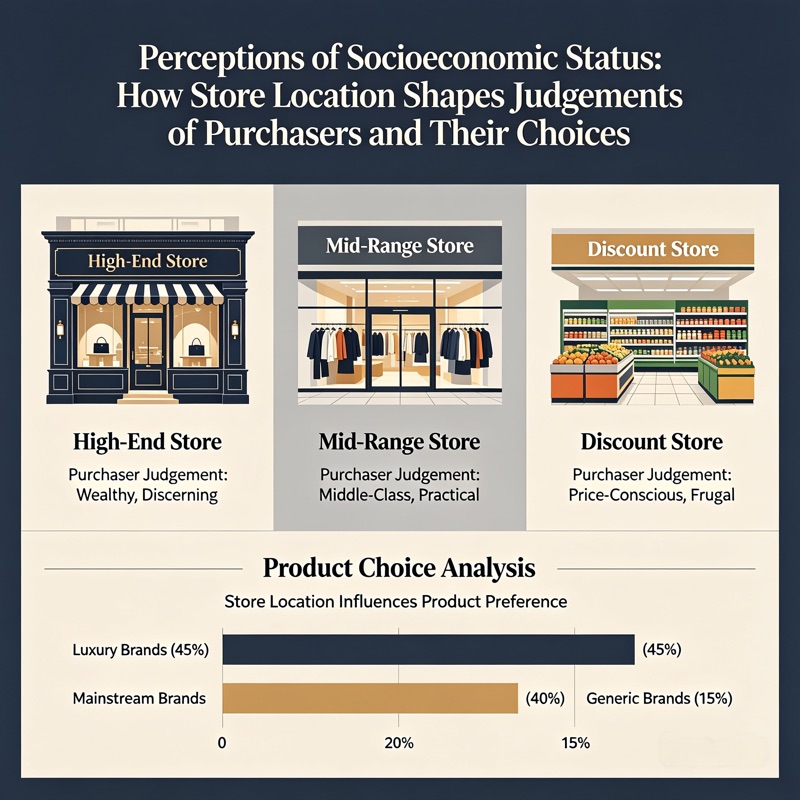
In the complex social calculus of modern life, we often judge people not only by what they wear or own, but by where they acquired it. Store location—whether a boutique on a luxury avenue, a bustling local market, a suburban mall, or a discount outlet—acts as a powerful visual and social cue that triggers automatic assumptions about a person’s income, background, taste, and even moral character. This phenomenon reveals a fascinating truth: the physical address of a business carries a social weight that can sometimes overshadow the actual quality, value, or meaning of the items purchased. It turns shopping into a performance, and geography into a social label. Understanding how location shapes our perceptions is essential to challenging unfair biases and recognizing that true value and style exist far beyond the boundaries of a neighborhood or a street name.
THE GEOGRAPHY OF STATUS: HOW LOCATION BECOMES A SYMBOL
From the earliest days of urban development, the layout of cities has reflected social hierarchy. Districts were historically divided by wealth and class, with the most affluent families residing and conducting business in the most central, accessible, and prestigious areas. Over time, this association became deeply ingrained in collective consciousness. Today, certain streets, districts, and even entire cities have become global shorthand for luxury, exclusivity, and high social standing—think Fifth Avenue in New York, the Champs-Élysées in Paris, Bond Street in London, or Makati Avenue and Greenbelt in Metro Manila. Conversely, other areas are quickly categorized as “budget,” “practical,” or even “low-end,” regardless of what is actually sold there.
This labeling creates a mental map that we all carry around. When we hear someone shopped at a store in a renowned luxury district, we immediately form an image: we assume they have significant disposable income, value prestige, and move in certain social circles. If we learn they bought the same or similar item from a store in a suburban complex, a local market, or an online discount platform, our perception shifts instantly—often assuming lower income, lesser taste, or a need to save money. The irony is striking: the product itself may be identical, made from the same materials, produced in the same factory, and offer the same level of quality. Yet simply changing its location changes its perceived value and the character of the person buying it.
This is not just a matter of personal opinion; it is reinforced by the retail industry itself. Luxury brands intentionally choose prime, high-rent locations not merely for foot traffic, but to signal exclusivity. The cost of the real estate is factored into the price of the goods, effectively selling the address as much as the product. In this system, the store becomes a social filter: being seen there is a statement, and being seen shopping elsewhere can be interpreted as a lack of means or status.
HOW LOCATION SHAPES JUDGEMENTS OF THE SHOPPER
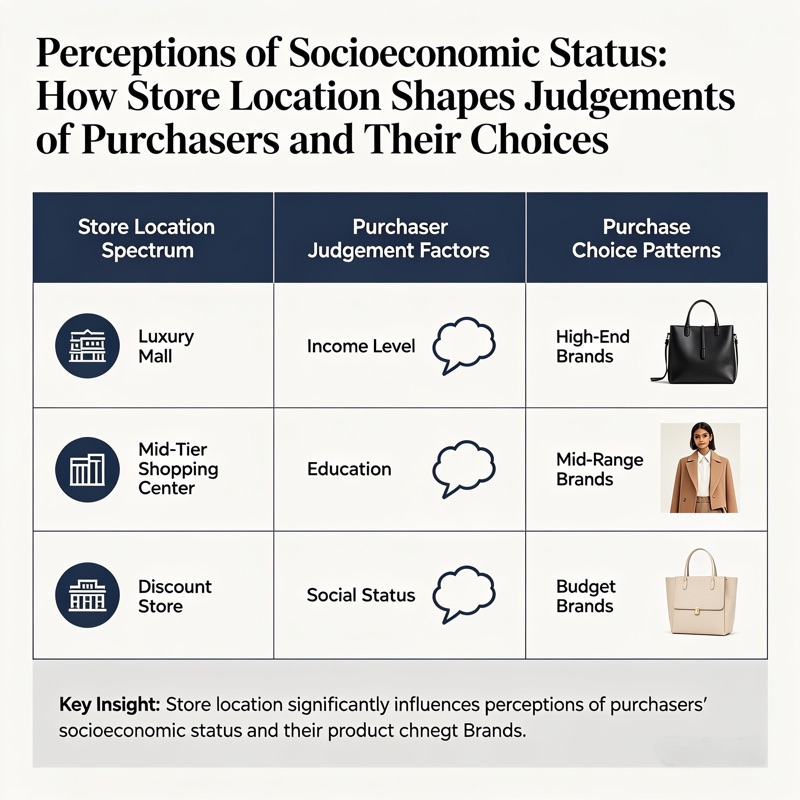
The influence of store location extends far beyond the item purchased; it fundamentally changes how we view the person holding the shopping bag. Research and social observation show that we apply a consistent, often unspoken set of assumptions based solely on where someone shops:
The “Prestige District” Effect
Shoppers seen in high-end areas are frequently attributed with positive traits: success, refinement, education, and high social standing. Even if they are browsing, comparing prices, or looking for a sale, they are often perceived as people who can afford luxury. There is a default assumption that they are making choices based on quality and taste, rather than necessity. This perception can even translate into real-world advantages—studies have shown that people carrying shopping bags from luxury stores are often treated with more deference, given better service, and perceived as more trustworthy or authoritative in professional and social settings.
The “Everyday Retail” Bias
On the other hand, shoppers in malls, department stores, or local shops are often placed in a neutral or middle category. They are seen as “average” or “practical,” making sensible choices. However, this can also carry a subtle implication: they are not part of the elite, and their choices are driven by budget rather than desire or discernment. Even if they purchase an item of equal or higher quality to something found in a luxury district, the context of the store dilutes its perceived value.
The “Discount & Market” Stigma
Perhaps the most striking example of location-based judgment is the stigma attached to budget stores, outlets, and public markets. There is a widespread, unfair assumption that anyone shopping in these places does so only because they cannot afford anything better. This ignores the many valid reasons people choose these locations: they may prioritize sustainability, enjoy the thrill of finding unique pieces, support local artisans, or simply refuse to pay inflated prices for a brand name or a fancy address. Yet, society often reduces these choices to a single narrative: financial limitation. This creates a double standard: a wealthy person who shops at a market is often praised as “practical” or “authentic,” while someone of modest means doing the same is often pitied or judged.
THE PSYCHOLOGY BEHIND THE BIAS: WHY WE RELY ON LOCATION
Why do we trust the location of a store more than the evidence of our own eyes? This behavior stems from a psychological shortcut known as heuristic thinking. In a complex world, we look for quick, visible clues to understand people and situations without investing too much time or effort. Store location is an easy, visible signal—it is public, consistent, and widely understood.
Furthermore, we live in a culture that often equates cost with value, and location with cost. We assume that because a store pays higher rent, it must sell better products, and because it sells better products, only “better off” people shop there. We also tend to confuse display with substance. A sleek, minimalist interior, expensive lighting, and polished service create an atmosphere of exclusivity that makes us feel that everything inside must be superior—even if the construction of the garments or goods is identical to those found elsewhere.
Social comparison theory also plays a major role. We constantly measure ourselves against others, and store locations provide a clear benchmark. They help us define where we believe we stand in the social hierarchy and where others stand. For some, shopping in prestigious areas is a way to signal belonging or success; for others, the pressure to avoid “lower-status” locations can be intense, leading to unnecessary spending or debt just to maintain a certain image.
THE REALITY: CHOICE VS. NECESSITY
The biggest flaw in judging people by where they shop is that it ignores the complexity of human choice. Socioeconomic status is not the only factor that determines where someone spends their money. In fact, in recent years, the lines have blurred significantly, and shopping habits are becoming less about class and more about individual values:
• Values Over Status: Many people with significant financial means deliberately choose to shop in local markets, thrift stores, or independent boutiques rather than luxury districts. They may prioritize supporting small businesses, reducing their environmental impact, finding one-of-a-kind pieces, or simply refusing to pay the “prestige markup.” For them, paying for a fancy address feels like a waste of money, not a mark of success.
• Quality Over Label: A growing number of consumers understand that price and location do not always equal quality. A well-made garment from a local artisan or a reputable brand sold in a mid-range store can be far more durable and beautiful than a mass-produced item with a famous name sold in a high-rent district.
• Access and Preference: Practicality also plays a huge role. A person may live far from luxury districts, prefer the convenience of a local mall, or enjoy the social atmosphere of a public market. Location is often a matter of geography, lifestyle, and personal comfort—not bank balance.
• The Myth of “The Affluent Shopper”: Conversely, the person walking out of the most expensive store may not be wealthy at all. They may be buying on credit, saving for months, or purchasing an item as a gift. Judging their net worth or character based solely on the store’s address is a leap of logic that is often incorrect.
This reality is perfectly illustrated in the world of fashion and style we often discuss. Icons like Catriona Gray, Heart Evangelista, and Sabrina Carpenter all demonstrate that true style is not tied to a specific zip code. They can look equally stunning in a custom gown from a world-famous designer, a beautifully crafted piece from a local Filipino artisan, or a carefully selected item from a more accessible brand. The magic lies in how it is worn and the story behind it—not where it was bought.
THE IMPACT OF LOCATION BIAS
The habit of judging others by store location has real consequences for individuals and society. It creates an unfair system where people are treated differently based on a perceived status rather than their actual character or the value of their choices. It can lead to feelings of inadequacy for those who cannot or choose not to shop in certain areas, and it can create a false sense of superiority for those who do.
For businesses, this bias can also be harmful. It means that talented designers, skilled artisans, and high-quality brands located in less affluent areas may be overlooked simply because of their address, while similar products in prime locations are overvalued. It perpetuates inequality by reinforcing the idea that success and worth are tied to specific neighborhoods, rather than to hard work, talent, and integrity.
Most importantly, this bias limits our own perspective. When we look at a shopping bag and immediately assign a value to the person carrying it, we stop seeing them as an individual. We reduce them to a stereotype based on geography, and we miss the opportunity to appreciate their taste, their values, and their unique story.
REDEFINING WORTH: LOOKING BEYOND THE ADDRESS
Breaking free from the habit of judging by store location requires a conscious shift in perspective. It means learning to separate the symbolism of a place from the reality of the people and products within it.
True discernment looks at the item itself: Is it well-made? Does it serve its purpose? Does it bring joy to the owner? And more importantly, it looks at the person: Are they honest? Kind? Hardworking? Creative? These qualities have no address. They can be found in every district, every market, and every store in the world.
We must also recognize that the social value attached to certain locations is a human-made construct. It is a system designed to create distinction and desire, but it does not define reality. A beautiful, well-crafted dress purchased in a local market has exactly the same ability to make someone feel confident and elegant as one bought on a famous avenue. The only difference is the extra cost paid for the location—and the unfair assumptions people might make.
At G&T Hollywood Models, we believe that style, value, and dignity are universal. They are not confined to specific streets or zip codes. The most impressive thing about a person is never where they shop, but why they shop there—what they value, what they support, and how they carry themselves. A shopper who chooses local because they want to help their community, or who chooses sustainable because they care for the planet, or who chooses budget because they are saving for a meaningful goal, is making a choice far more worthy of respect than someone who shops somewhere only to impress others.
CONCLUSION: THE TRUE LOCATION OF VALUE
Perceptions of socioeconomic status will always be influenced by the world around us, but we have the power to decide what we choose to see. Store location is just one small detail in the vast story of a person’s life. It tells us nothing about their intelligence, their kindness, their success, or their worth. It is merely a point on a map, not a measure of a human being.
As we move forward, let us train ourselves to look past the street name, the building facade, and the neighborhood reputation. Let us judge the choice, not the location; the character, not the address. When we do, we discover that value is everywhere—found in the finest boutiques and the humblest markets alike. And we realize that the most important “location” of all is the heart and mind of the person making the choice.
“A great style can be found anywhere, but a great person shines everywhere—no matter where they choose to shop.”


Comments
Post a Comment